NFC vs paper business cards: what actually changes
Do NFC business cards really replace paper cards?
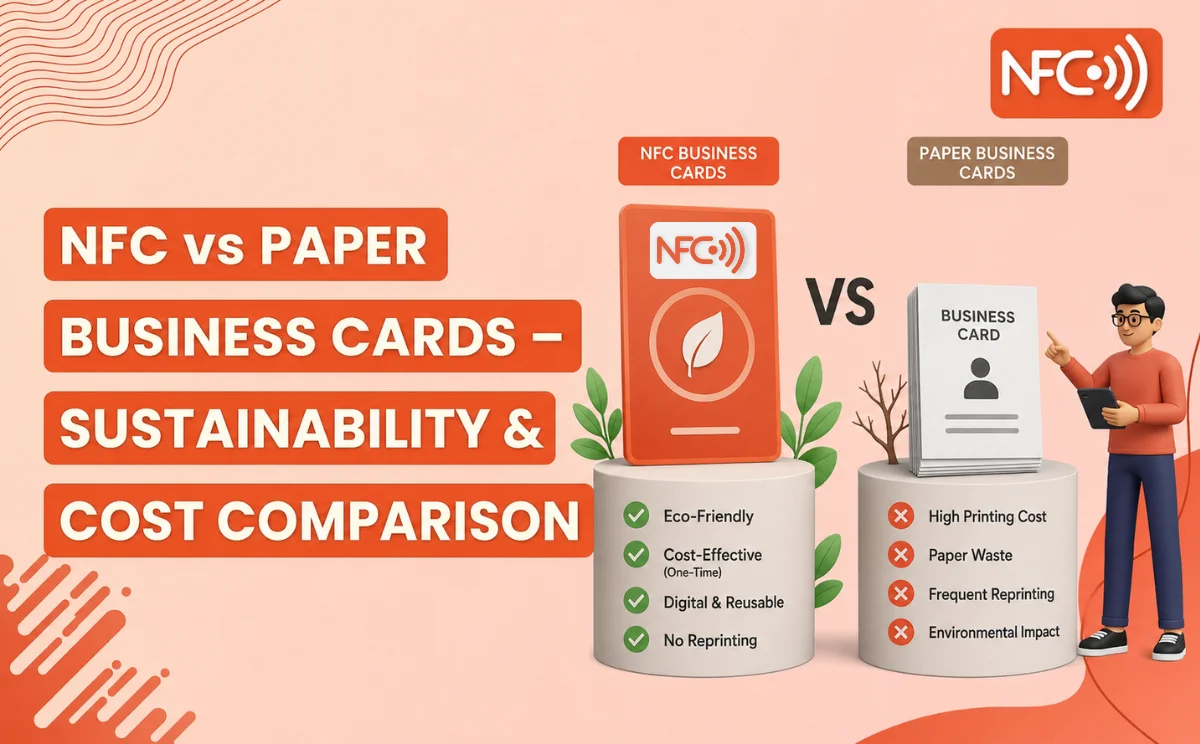
Yes, for most professional networking situations. An NFC card shares your full profile — contact details, socials, portfolio — in one tap, and updates instantly when your information changes. A paper card is fixed the moment it’s printed and gets discarded far more often than people realize.
What happens to paper business cards after they’re handed out?
Most paper cards are lost, misplaced, or thrown away within a week of being received — studies on business card retention consistently find that fewer than 1 in 10 survive long enough to be acted on. An NFC card avoids this entirely: the receiver saves your contact directly to their phone in the same tap that opens your profile.
How much does a company actually save by switching to NFC?
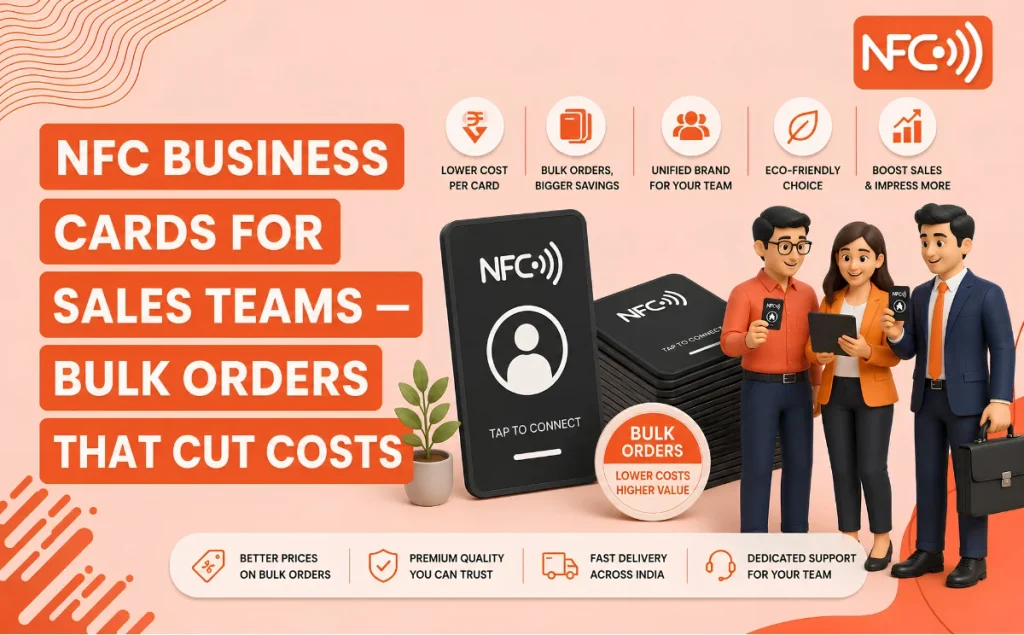
The direct comparison is reprint cost vs. one-time cost. Every time someone’s title, number, or company changes, paper cards need reprinting — for a 20-person sales team changing roles or numbers even twice a year, that’s 40+ reprint cycles. An NFC card at ₹1,500 (one-time) never needs reprinting: the physical card stays the same, only the linked profile updates.
Is NFC actually better for the environment?
Yes, in a straightforward way — every paper card avoided is one less card printed, transported, and thrown away. NFC removes the reprint cycle entirely, which is where most of a paper card’s environmental cost accumulates over a person’s career, not just the first print run.
What’s the real networking advantage?
Follow-up rate. A paper card requires the receiver to manually type or photograph your details later — many simply never do. An NFC tap saves your contact and opens your full profile (with links to your work, socials, or booking page) in the same motion, at the moment interest is highest.
When does paper still make sense?
Rarely, but not never — some very traditional industries or older clients may still expect a physical card exchange as a courtesy. A practical middle ground many professionals use: carry an NFC card that also has your name/title printed on it, so it functions as a paper card visually while working as a digital one on tap.
If you meet new contacts more than a few times a month, the reprint savings and follow-up rate alone justify the one-time ₹1,500 cost of an NFC card within the first few months.
FAQs
No. The physical card lasts indefinitely; only the linked digital profile is updated, which you can do anytime at no extra cost.
Yes — NFCCard designs include your name and title printed on the card face alongside the embedded NFC chip.